
Mary Roach
Books: Science | Culture
Stiff: The Curious Lives of Human Cadavers (2003), Spook: Science Tackles the Afterlife (2005), Gulp: Adventures on the Alimentary Canal (2013), My Planet: Finding Humor in the Oddest Places (2013)
Anthology
The Best American Science and Nature Writing 2011 (2011)
Stiff: The Curious Lives of Human Cadavers (2003)
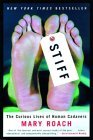 I was wandering the bookstore and Stiff was sitting on one of the display tables, one of the "Recommended Summer Reading" tables or something like that. I'd heard a review or interview or something like that when it first came out, but never ran across it, and forgot about it, but I remembered hearing/reading about it, and so picked it up to flip through it. I glanced at Chapter 1:
The human head is of the same approximate size and weight as a roaster chicken. I had never before had occasion to make the comparison, for never before today have I seen a head in a roasting pan, resting face up on what looks to be a small pet-food bowl. The heads are for plastic surgeons, two per head, to practice on. I'm observing a facial anatomy and face-lift refresher course, sponsored by a medical center sponsored by a southern university medical center and led by a half-dozen of America's most sought-after face-lifters.
The heads have been put in roasting pans–which are of the disposable aluminum variety–for the same reason chickens are put in roasting pans: to catch the drippings. Surgery, even surgery upon the dead, is a tidy, orderly affair.
After that, I kept reading as I wandered back to find Michael, and continued reading all the way to the checkout line.
I thoroughly enjoyed Stiff.
Mary Roach's writing style was both entertaining and engaging, and never morbid, which was a distinct possibility considering the subject matter. Although her tone was entertaining, I don't think feel that she was ever disrespectful. Although, she seems to believe that a corpse is only a shell where someone used to live. After death, whatever creates or causes life has disappeared.
The book covers different areas of what happens to corpses. Donated bodies can be used for practice surgery, she discusses the history of body snatching, there is a study of the decay and decomposition of human bodies, the use of bodies to test safety devices, autopsy to determine what happened in a crash, the use of cadavers to determine what happens to bodies who are exposed to bombs and bullets, crucifixion experiments, brain death and the fear of live burial, head transplants, medical cannibalism, the disposal of human remains, and what the author plans to have done with her remains.
My favorite chapters were the ones on what happens to bodies that have been donated to science, including the ethics of using those bodies for different kinds of experiments and testing.
If you have a morbid curiosity, or are just curious about what happens to your body when you die, then you may want to check out Stiff, it's a fascinating look at cadavers and corpses and scientific experimentation.
Rating: 8/10
Spook: Science Tackles the Afterlife (2005)
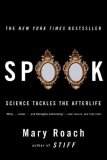 As much as I enjoyed Stiff, I found Spook disappointing. As a scientific look at life after death, excluding the last couple chapters, it read more as a debunking than a presentation.
Of course that's partially because several chapters deal with things like ectoplasm exuding from mediums, which was a short lived phenomenon, and so the "research" into it seems… unnecessary, although I admit that the chapters on where the mediums may or may not have hidden the "ectoplasm" was both titillating and disturbing.
The chapters I did find interesting were on electromagnetic fields and low frequency sounds, and how they can cause repeatable phenomenon in a portion of the population. The idea that EMF and sounds beneath our hearing range can cause us to hear and see things that are not there is fascinating.
And although I liked the chapter on Near Death Experiences, it seemed short, at least in comparison the the amount of time spent on mediums and ectoplasm. It feels as if there should be far more research on the subject (after all, there was a movie on the subject) and that the chapter should have been a little longer. Not that the information I learned about turn of the last century mediums wasn't interesting, it just didn't seem the slightest bit relevant.
As always, the book is full of Roach's characteristic wit and sarcasm, much of it to be found in the footnotes. And the footnotes ranged from completely irrelevant to occasionally more interesting than the text.
All in all, although interesting, the book felt far more uneven than Stiff. Interesting, but I'm not sure it was worth the trade paperback price.
Rating: 6/10
The Best American Science and Nature Writing 2011 (2011)
edited by Mary Roach and Tim Folger
 I'll admit I bought this because 1) it was on sale and 2) because it was edited by Mary Roach. I have no idea is Mary Roach is a good editor or not on her own, but I love her writing, so I figured, why not?
This is a collection what was decided to be some of the best science writing of the previous year.
This must be an extremely difficult anthology to put together, since science writing covers so much ground, from organ sales to fracking to neurology to epidemiology.
Here are some of the passages that amused me.
From "Nature's Spoils" by Burkhard Bilger,
Strictly speaking, all fermentation is anaerobic (it doesn't consume oxygen); most rot is anaerobic. But the two are separated less by process than by product. One makes food healthy and delicious; the other not so much.
By 1800 B.C. the Sumerians were worshiping Ninkasi, the goddess of beer.
(who doesn't need to know the name of the Sumerian goddess of beer?
From "The Brain That Changed Everything" by Luke Dittrich,
Brain surgery, whatever the era, always requires at least two frightening qualities in its practitioners: the will to make forcible entry into another skull and the hubris to believe you can fix the problems inside.
From "Letting Go" by Atul Gawande,
People die only once. They have no experience to draw upon.
This is probably one of the best summations of the importance of end-of-life care I have ever read. And I have read a lot of books and articles on end-of-life care.
From "Sign Here If You Exist" by Jill Quinn,
Darwin, on the other hand, swayed no doubt by the rather macabre details of the parasitic insect (ichneumon wasp)'s life, writes, "I cannot persuade myself that a beneficent and omnipotent God would have designedly created the Ichneumonidae with the express intention of their feeding within the living bodies of Caterpillars"
According to Alan F. Segal, in Life After Death, my position is not unique: more Americans believe in an afterlife than in God himself. Furthermore, the General Social Survey he cites…Jewish believe in an afterlife has jumped from 17 percent (as recorded by those born between 1900 and 1910) to 74 percent (as recorded by those born after 1970).
I find that absolutely stunning.
From "The New King of the Sea" by Abigail Tucker,
The descendants of those ancient jellies haven't changed much. They are boneless and bloodless. In their domelike bells, guts are squished beside gonads. The mouth doubles as an anus. (Jellies are also brainless, "so they don't have to contemplate that," on jelly specialist says.)
As much as I love watching jellies, I don't like them taking over areas they weren't before, and killing off other oceanic species.
A couple of the essays were–unsurprisingly–sad and depressing, but all of them were thought provoking and interesting. But I do wish the collection had ended on a less depressing note.
Published by Houghton Mifflin Harcourt
Rating: 9/10
Gulp: Adventures on the Alimentary Canal (2013)
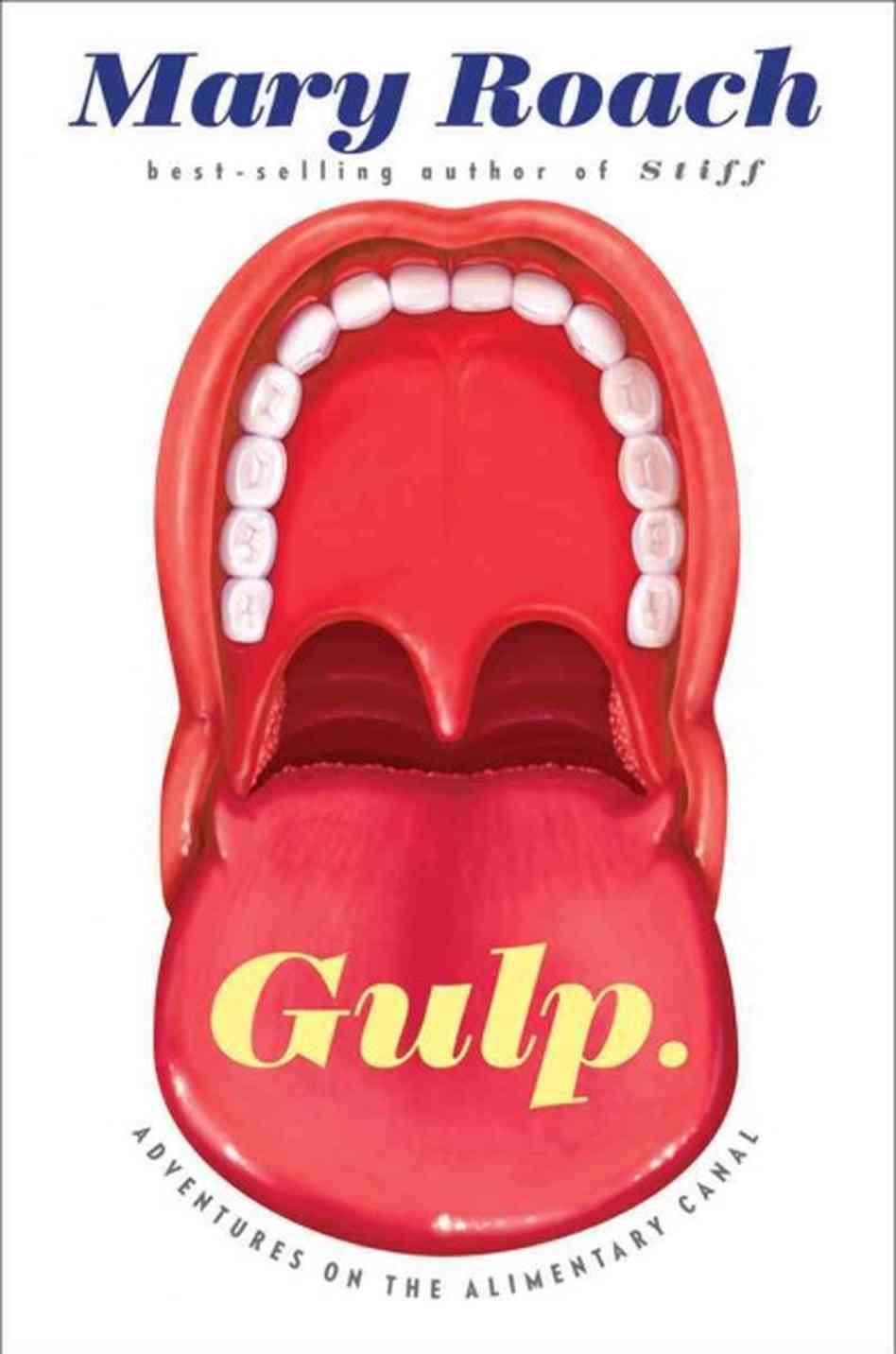 I love Mary Roach. I would love to be trapped in an elevator with her (unless she's claustrophobic, in which case, that seems unfair).
She is a science fan-girl of the best kind, and is unafraid to get into the nitty gritty details (and believe me, there are plenty of gritty details).
In 2009, the United States exported 438,000 tons of frozen livestock organs. You could lay them end to end and make a viscera equator.
One serving from the Fruits and Vegetables Group in Nirlungayuk's materials is "1/ 2 cup berries or greens, or 60 to 90 grams of organ meats."
Americans preferred bland preparations of muscle meat partly because for as long as they could recall, that's what the upper class ate.
So powerful are race- and status-based disgusts that explorers have starved to death rather than eat like the locals.
And there are footnotes! I love footnotes!
So great was the Victorian taste for order that displaced organs constituted a medical diagnosis. Doctors had been misled not by plastic models, but by cadavers and surgical patients— whose organs ride higher because the body is horizontal. The debut of X-rays, for which patients sit up and guts slosh downward, spawned a fad for surgery on "dropped organs"— hundreds of body parts needlessly hitched up and sewn in place.
As well as bits of wisdom:
there is a point at which efficiency crosses over into lunacy, and the savings in money or resources cease to be worthwhile in light of the price paid in other ways.
There are many tasks I refuse to do, because I value my time more than my money.
Which doesn't explain why I blog every book I read, does it?
But of course why I love Mary Roach best is her humor.
This suggests that saliva —or better yet, infant drool— could be used to pretreat food stains. Laundry detergents boast about the enzymes they contain. Are these literally digestive enzymes? I sent an e-mail to the American Cleaning Institute, which sounds like a cutting-edge research facility but is really just a trade group formerly and less spiffily known as the Soap and Detergent Association.
With no detectable appreciation for the irony of what he had written, press person Brian Sansoni referred me to a chemist named Luis Spitz. And when Dr. Spitz replied, "Sorry, I only know soap-related subjects ," Sansoni— still without a trace of glee— gave me the phone number of a detergent industry consultant named Keith Grime.
I mean, how could you NOT love this bit?
(The whisking of semen is complicated by its coagulating factor. Should you wish to know more, I direct you to the mucilaginous strands of the World Wide Web.)
I think I highlighted most of the entire section on whether you could survive in the stomach of a whale. And also the entire section on the "prison wallet" or rectum.
And the entire chapter on defecation was fascinating and disturbing.
It (Cardio-vascular Events at Defecation) happens often enough that stool softeners are administered as a matter of course on coronary-care wards.
I mean, I was so curious about the bit about Elvis, I (warily) did a google search on megacolon. (Do so at your own risk. You have been warned.)
I finished this book with a sense of profound gratefulness that I have a normal, healthy, alimentary canal. Not that I didn't feel that way before–I lived with a woman who visited the Digestive Disorders department at the doctor's office on a regular basis for multiple problems–but this reminded me just how lucky I am.
I feel like I should go eat something to celebrate.
Published by W. W. Norton & Company
Rating: 10/10
My Planet: Finding Humor in the Oddest Places (2013)

(T)he complete collection of her "My Planet" articles published in Reader's Digest. She was a hit columnist in the magazine, and this book features the articles she wrote in that time.
I adore Mary Roach's writing. She makes me laugh, but also writes about all KINDS of fascinating things, like corpses and what happens to them.
This is a collection of short essays, some better than others, but sometimes you need a quick and amusing story.
Home repair projects around our house generally fall into two categories: "I'll get to that this weekend" and "I'll get to that this summer." Followed by an eventual shift to a third category: "I'll get the Yellow Pages."
My mother always fed our cats PET milk, and I'd assumed it was a special inexpensive kind of milk for pets. "Why, sure," said Ed. "It's shelved right there next to the IDIOT Milk."
I believe prewashing is demeaning to the dishwasher. If people wash the dishes first, the dishwasher is reduced to a sort of unneeded front-loading autoclave.
It is an amusing collection, and I picked it up on sale. I don't think I'd recommend paying the list price for it, but on sale it was amusing.
Published by Reader's Digest
Rating: 7/10